SharePoint CVE-2026-65660: The "Spoofing" Bug That Turned Out to Be Remote Code Execution
An authenticated code injection flaw in on-premises SharePoint is now exploited in the wild — and the servers it lands on are the ones that already held your documents, your credentials, and your trust
Date: September 25, 2026 Primary Source: The Hacker News · CISA
Executive Summary
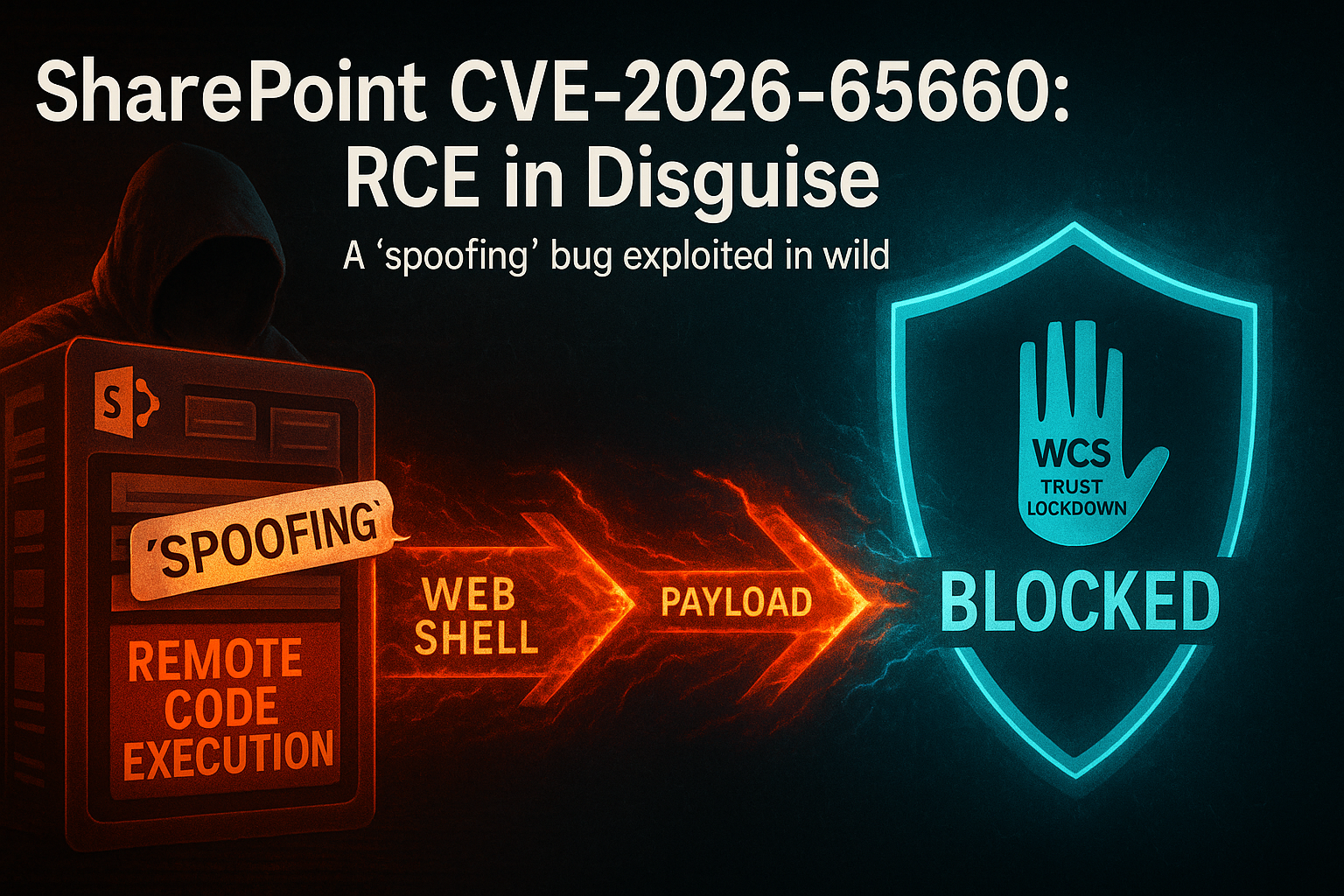
- What: CVE-2026-65660 is a code injection vulnerability in on-premises Microsoft SharePoint Server that lets an authenticated attacker execute code on the server over the network. On September 25, 2026, Microsoft stated it has reliable evidence of observed attacks, and CISA added the flaw to its Known Exploited Vulnerabilities (KEV) catalog the same day. (The Hacker News) (CISA)
- Who is affected: SharePoint Server 2016, 2019, and Subscription Edition below the August 2026 fixed builds. SharePoint Online (Microsoft 365) is not listed as affected. (Canadian Centre for Cyber Security)
- Severity: High — CVSS 8.8 per NVD. Microsoft originally published it as a spoofing vulnerability rated 6.5, which led many teams to deprioritize it. (The Hacker News)
- Action required: Confirm every SharePoint farm is at or above 16.0.19725.20522 (Subscription Edition), 16.0.10417.20198 (2019), or 16.0.5565.1001 (2016). The fix shipped on August 11, 2026. (Canadian Centre for Cyber Security)
- The honest scope note: White Cloud Security does not patch SharePoint, and it does not stop the injected .NET code that runs inside the SharePoint worker process. What it governs is what happens next: whether that foothold can launch tools, drop payloads, and turn into ransomware on the server and the hosts it can reach.
Overview
When Microsoft released its August 11, 2026 security updates, CVE-2026-65660 was listed as a SharePoint Server spoofing vulnerability with a moderate CVSS score of 6.5. Patch-prioritization workflows that sort by vendor severity and impact type pushed it down the list. Then, on September 11, the CVE record was updated to describe it as a remote code execution vulnerability that "allows an authorized attacker to execute code," and NVD scored it 8.8. (The Hacker News)
On September 22, the researcher who found the flaw, Dinh Ho Anh Khoa of Viettel Cyber Security, published a technical write-up with working exploit markup. It's the same researcher who demonstrated the 2025 ToolShell SharePoint chain at Pwn2Own Berlin, which state-backed groups later used in the wild. (The Hacker News) Three days later, Microsoft said it had reliable evidence of attacks, and CISA added CVE-2026-65660 to the KEV catalog alongside a MikroTik RouterOS flaw. (The Hacker News) (CISA)
Microsoft has not named a threat actor, a victim count, or a payload. (The Hacker News) We won't fill that gap with guesses. The pattern is familiar, though: a flaw in an internet-facing collaboration server, a public exploit, and exploitation within days. SharePoint servers hold sensitive documents and privileged service accounts, and they usually have broad network reach, which makes them valuable targets.
Threat Summary
| Field | Detail |
|---|---|
| CVE ID | CVE-2026-65660 |
| CVSS Score | 8.8 (NVD); Microsoft's advisory originally rated it 6.5 as spoofing (The Hacker News) |
| Weakness | CWE-94 — Improper Control of Generation of Code (code injection) |
| Affected products | SharePoint Enterprise Server 2016, SharePoint Server 2019, SharePoint Server Subscription Edition (Canadian Centre for Cyber Security) |
| Fixed builds | 2016: 16.0.5565.1001 · 2019: 16.0.10417.20198 · SE: 16.0.19725.20522 (Canadian Centre for Cyber Security) |
| Attack vector | Network — requires an authenticated SharePoint user |
| Exploited in the wild | Yes — Microsoft confirmed on September 25, 2026; added to CISA KEV the same day (The Hacker News) (CISA) |
| Public exploit | Yes — researcher write-up with exploit markup published September 22, 2026 (The Hacker News) |
| Patch available | Yes — August 11, 2026 security updates (The Hacker News) |
| Attribution | None published |
Technical Analysis
How the Attack Works
SharePoint only lets a page load server controls that are listed as approved in the SafeControls list. CVE-2026-65660 is a way around that check.
- Obtain an authenticated session. The flaw requires an authorized user (MITRE ATT&CK T1078, Valid Accounts). That bar is lower than it sounds. Phished or reused credentials meet it. So does a forged token from CVE-2026-55040, a SharePoint JWT authentication bypass rated CVSS 9.1, patched in July and exploited within a day of Rapid7's proof of concept on August 11. (Rapid7) (SecurityWeek) Canada's Cyber Centre warns that chaining CVE-2026-65660 with other SharePoint flaws can enable pre-authentication code execution on servers that allow anonymous access. (Canadian Centre for Cyber Security)
- Inject a directive through the ToolPane. When SharePoint's ToolPane component processes web-part markup, it rebuilds
<%@ Register %>directives by writing attribute values between double quotes without escaping quotes inside them. A crafted value breaks out of its attribute and adds a directive of the attacker's choosing. (The Hacker News) - Get past SafeControls. The injected directive registers an arbitrary .NET type after the SafeControls check has already run but before the control is loaded. (The Hacker News)
- Execute code. The published technique uses
XamlServices.Parse()to reach code execution (T1190, Exploit Public-Facing Application; T1059, Command and Scripting Interpreter). The code runs as the SharePoint application pool identity inside the IIS worker process,w3wp.exe. (The Hacker News)
Payload and Impact
The researcher's proof of concept deliberately uses an in-memory webshell, meaning nothing is written to disk. The reason is instructive: gadget chains that drop files tend to fail against the least-privilege configuration many farms actually run. (The CyberSec Guru) Defenders should take the point seriously. The first stage of this attack is .NET code running inside a process that's supposed to be running.
What attackers do with a SharePoint foothold is well documented from the 2025 ToolShell campaign. In that campaign, Microsoft observed attackers stealing ASP.NET machine keys so their access outlived the patch. They also ran Mimikatz to dump credentials from LSASS, moved laterally with PsExec and Impacket, and, for the group Microsoft tracks as Storm-2603, deployed Warlock ransomware across victim environments. (Microsoft Security) No one has published a payload for CVE-2026-65660 yet. Whatever it turns out to be, it will have to run as code on the server or on the hosts behind it.
Why Traditional Defenses Struggle
- Severity labels drive patching, and this one was wrong. A flaw published as moderate-severity "spoofing" doesn't get emergency treatment. Teams that triaged by Microsoft's original classification may have left servers unpatched for six weeks. (The Hacker News)
- The first stage has no file to scan. An in-memory webshell loaded into
w3wp.exegives signature-based antivirus nothing to match on disk. - The request looks like normal SharePoint traffic. The exploit is an authenticated POST to a standard layouts page. Web application firewall rules written for one payload shape are easily varied.
- Detection is after the fact. EDR can flag
w3wp.exespawningcmd.exeorpowershell.exe, and it should. But an alert on a process that already ran is still an incident to investigate. Against a ransomware affiliate with domain credentials, the time between that alert and encryption can be short. - Machine keys outlive the patch. If validation keys were stolen before you patched, patching alone does not remove the attacker's access. (The CyberSec Guru)
How White Cloud Security Trust Lockdown Stops This
Two things are true at once, and leaving out either one would be dishonest.
White Cloud Security would not prevent the injection itself. The vulnerable code is SharePoint's own. The exploit runs as .NET code inside w3wp.exe, which is a legitimate, approved process that has to keep running for SharePoint to work. Application control doesn't inspect the web-part markup an approved process is handed. The fix for the vulnerability is the August patch.
What White Cloud Security governs is every step after that. Those later steps turn a webshell into a breach.
Least-Privilege Zero-Trust App Firewall
White Cloud Security (WCS) Trust Lockdown™ enforces Default-Deny Zero-Trust Application Control: only applications, libraries, and scripts explicitly approved for an endpoint are permitted to execute. Here is how that maps to the chain above and to what attackers did after ToolShell:
| Attack step | White Cloud Security control |
|---|---|
| 1. Authenticate (stolen credential or CVE-2026-55040 forged token) | Not covered. Identity controls, MFA, and patching for CVE-2026-55040 apply here. |
2–4. ToolPane directive injection → .NET code executes in w3wp.exe |
Not covered. This code runs inside an approved process. Patch to the August 2026 builds. |
| 5. Webshell drops an attacker tool: a tunneler, remote access tool, Cobalt Strike-style beacon, or custom loader | Denied at execution. It has no handprint entry and no approved code-signing certificate, so it does not run, whatever account w3wp.exe runs under. |
| 6. Credential theft with a dumper such as Mimikatz | Denied at execution. A credential-dumping binary is not on an approved list for a SharePoint server. |
| 7. Scripts written to disk and launched from the webshell | Denied unless approved. Trust Lockdown governs scripts as well as executables, so an unapproved script dropped to a temp folder doesn't get to run. |
| 8. Lateral movement to other hosts (PsExec, Impacket-built tools, remote services) | Denied at execution on WCS-protected hosts. A service binary pushed to another host still meets that host's default-deny policy. |
| 9. Ransomware encryptor (as with Warlock after ToolShell) | Denied at execution. The encryptor is an unapproved executable, and that's the step default-deny exists to stop. |
Execution control doesn't consult identity or intent. It doesn't matter that the process asking to run something is the trusted SharePoint worker, or that the account behind it has farm-admin rights. The only question is whether the file about to run is on the approved list for that host.
Trust Lockdown policies can also limit the living-off-the-land path. Administrative interpreters and dual-use tools can be restricted to the systems and contexts where they're genuinely needed, so a web front-end server doesn't become an unrestricted launcher for whatever the webshell asks for.
Handprint Identity
Approval in White Cloud Security isn't based on a filename or a folder path. An attacker with write access to a SharePoint server controls both. Files are identified by handprint: a combination of SHA-1, SHA-256, SHA-512, MD5, CRC32, and file length. A credential dumper renamed to w3wp.exe, or a beacon dropped into the SharePoint LAYOUTS folder, still fails the check, because policy evaluates what the file is, not what it's called or where it sits. Legitimate Microsoft updates flow through Trust Profiles built on administrator-approved code-signing certificates, so patching SharePoint doesn't require a new approval for every build.
At White Cloud Security, we continue to track and report new hacking methods and tools — not just because of its immediate threat, but because patterns of reuse often expose the playbooks of these cybercriminal groups.
To state the limit plainly: this is containment of the blast radius, not prevention of the vulnerability. An attacker whose goal can be met entirely from inside w3wp.exe isn't stopped by execution control. That includes reading documents the app pool can reach, stealing machine keys, or querying the content database. Application control doesn't replace patching, MFA, key rotation, network segmentation, EDR, or backups. It's the layer that decides whether a SharePoint foothold can grow into credential theft, lateral movement, and ransomware.
Recommended Mitigations
- Patch now, and verify the build number. Update SharePoint Server 2016, 2019, and Subscription Edition to the August 2026 fixed builds or later, and confirm by build number rather than by assuming updates were applied. (Canadian Centre for Cyber Security)
- Patch CVE-2026-55040 too. The JWT authentication bypass fixed in July 2026 removes the "authenticated" precondition, and it's already on the KEV list. (SecurityWeek)
- Re-triage anything you deprioritized as "spoofing." CVE-2026-65660 shows that a vendor's initial impact classification can change. Follow CVE-record and KEV updates, not only the release-day advisory.
- Rotate ASP.NET machine keys, then restart IIS, on any farm that was unpatched and internet-reachable at any point since August 11. Rotate farm, service, and application-pool credentials too. Stolen validation keys outlive the patch. (The CyberSec Guru)
- Reduce exposure. Canada's Cyber Centre recommends restricting or eliminating direct internet exposure of SharePoint servers and enforcing MFA for administrators. (Canadian Centre for Cyber Security)
- Plan off end-of-life versions. SharePoint Server 2016 and 2019 reached end of support on July 15, 2026, so future flaws in them may not be fixed. (Canadian Centre for Cyber Security)
- Enable AMSI integration and hunt. Look for
w3wp.exespawningcmd.exe,powershell.exe,certutil.exe,mshta.exe, orrundll32.exe, and for unexpected.aspxfiles under theLAYOUTSdirectories. - Enforce Default-Deny application control on SharePoint servers and the hosts they can reach, so a webshell can't launch unapproved tools or ransomware.
Indicators of Compromise
Microsoft and CISA have not published indicators for in-the-wild CVE-2026-65660 activity, and we won't make them up. The researcher's published proof of concept gives these request-level hunting leads, which describe the public technique rather than any confirmed attacker: (The CyberSec Guru)
POSTrequests to/_layouts/15/AddGallery.aspx?DisplayMode=Edit- The
MSOTlPn_DWPparameter containing URL-encoded<%@ Registerdirectives - Unusually large request bodies (roughly 20 KB or more in the proof of concept)
- Command output or directory listings appearing in HTTP responses from layouts pages
Key Takeaways
- CVE-2026-65660 is exploited in the wild and on the CISA KEV list as of September 25, 2026. Patches have existed since August 11. (CISA) (The Hacker News)
- It was published as "spoofing" and turned out to be RCE. Patch priority based on the release-day label left a six-week window. (The Hacker News)
- "Authenticated" isn't much of a barrier. Stolen credentials or the separately exploited CVE-2026-55040 JWT bypass can supply the session. (Rapid7)
- Patching doesn't evict an attacker who already stole your machine keys. Rotate them.
- No endpoint product, White Cloud Security included, stops code that runs inside
w3wp.exe. The fix for the vulnerability is the patch. - White Cloud Security limits what the foothold can become. Default-Deny execution control, with files identified by handprint, would help block the credential dumpers, remote access tools, lateral-movement tools, and ransomware encryptors that turned the 2025 SharePoint wave into a ransomware campaign.
References
- The Hacker News — "SharePoint RCE and MikroTik RouterOS Flaws Actively Exploited in the Wild," September 26, 2026
- CISA — "CISA Adds Two Known Exploited Vulnerabilities to Catalog," September 25, 2026
- Canadian Centre for Cyber Security — "AL26-023 – Vulnerability impacting Microsoft SharePoint Server – CVE-2026-65660," September 24, 2026
- The Hacker News — "SharePoint Flaw Initially Listed as Spoofing by Microsoft Enables Authenticated RCE," September 22, 2026
- Rapid7 — "Microsoft SharePoint JWT Token Authentication Bypass Technical Analysis (CVE-2026-55040)"
- SecurityWeek — "SharePoint Vulnerability Exploited Shortly After PoC Release," August 12, 2026
- The CyberSec Guru — "CVE-2026-65660: Microsoft SharePoint RCE Exploit Explained"
- Microsoft Security — "Disrupting active exploitation of on-premises SharePoint vulnerabilities," July 22, 2025
- Microsoft Security Response Center — CVE-2026-65660
Further Reading
- Three CVSS 10.0 Flaws in ServiceNow: When the Workflow Platform Becomes a Remote Console
- A CVSS 10.0 in Your Identity Provider, and Nothing to Patch: Entra ID CVE-2026-69836
- When Ransomware Stops the Milk: The fairlife Attack and the IT-to-Operations Blast Radius
- Microsoft Defender RoguePlanet Zero-Day: When SYSTEM Privileges Are Not Enough
- Stryker, Shamoon, and the Case for Least Privilege Software Control
Microsoft and SharePoint are trademarks of Microsoft Corporation. Microsoft is not affiliated with, and does not endorse, White Cloud Security, Inc. Technical details of CVE-2026-65660 and CVE-2026-55040 are drawn from the sources linked above. Trust Lockdown™ is a trademark of White Cloud Security, Inc.