Three CVSS 10.0 Flaws in ServiceNow: When the Workflow Platform Becomes a Remote Console
Unauthenticated code execution and SQL injection in the Now Platform — and why the MID Server sitting inside your network is the part that should worry you most
Date: August 28, 2026 Primary Source: The Hacker News · ServiceNow KB3152242
Executive Summary
- What: ServiceNow disclosed four vulnerabilities on August 27, 2026 — CVE-2026-18885, CVE-2026-18886, and CVE-2026-74820, each rated CVSS 10.0, plus CVE-2026-6876 at CVSS 8.7. All four are exploitable by an unauthenticated attacker. (The Hacker News)
- Who is affected: Now Platform and ServiceNow AI Platform instances on the Xanadu, Yokohama, Zurich, and Australia release families below the fixed patch levels. (The Hacker News)
- Severity: Critical. The three maximum-severity flaws are network-reachable, low complexity, and require no privileges and no user interaction, with high confidentiality, integrity, and availability impact. (The Hacker News)
- Action required: Check your instance version against KB3152242 and apply the listed patch or hot fix. ServiceNow patches the instances it hosts; self-hosted and self-managed instances are your responsibility. (ServiceNow)
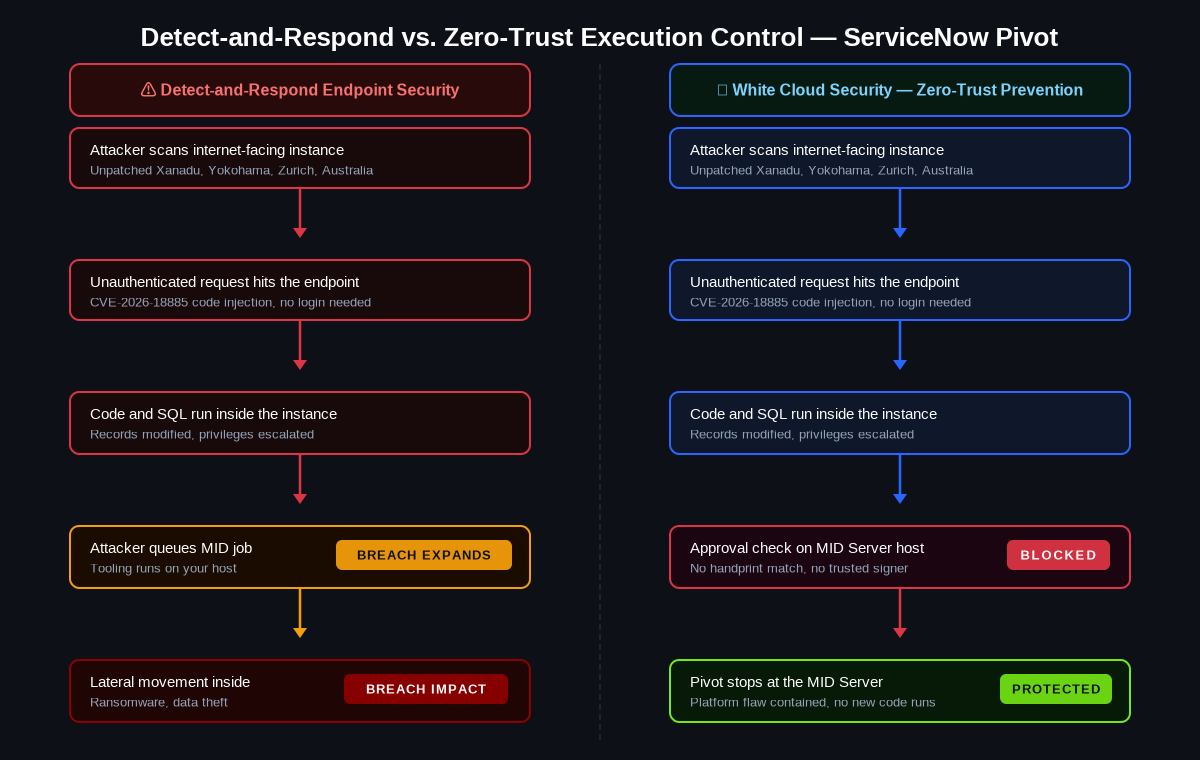
- The honest scope note: White Cloud Security does not patch ServiceNow and does not stop the injection itself. What it governs is the step after — what is allowed to execute on the Windows and Linux hosts the platform can reach.
Overview
ServiceNow is not a departmental tool. In most enterprises it holds the CMDB, the change records, the incident queue, the asset inventory, and the credentials or integration tokens that let all of that stay current. It is a workflow engine with privileged reach into the rest of the estate — which is exactly what makes an unauthenticated code execution flaw in it more consequential than the CVSS number alone suggests.
On August 27, 2026, ServiceNow published an advisory covering four issues. Three of them carry a CVSS score of 10.0, the maximum the scale allows, and each of the three can be reached by someone with no account, no credential, and no cooperating user. (The Hacker News) A fourth, CVE-2026-6876, is a sandbox escape in the Now Platform rated 8.7 that also permits unauthenticated arbitrary code execution. (The Hacker News)
ServiceNow says it "independently remediated each issue following findings from its internal security research and responsible disclosure program." (GBHackers) As of this writing there is no public exploit code and no confirmed in-the-wild exploitation for the four new CVEs. (The Hacker News)
That last sentence is doing a lot of work, and the recent history of this platform is the reason it should not be read as reassurance. In April 2026, Searchlight Cyber reported a different pre-authentication sandbox escape, CVE-2026-6875. ServiceNow shipped patches on July 14. Within days of the fix — and after Searchlight published a proof of concept — the threat intelligence firm Defused observed live exploitation attempts against the /assessment_thanks.do endpoint using a payload that matched the published PoC. (Help Net Security) (BleepingComputer) Defused then confirmed a second sandbox-escape gadget chain that bypassed defenses tuned to the published technique, meaning organizations that had blocked the known request pattern rather than patching the underlying flaw were still exposed. (SecurityWeek)
The gap between "no public exploit" and "exploited at scale" was measured in days last time.
Threat Summary
| Field | Detail |
|---|---|
| CVE IDs | CVE-2026-18885, CVE-2026-18886, CVE-2026-74820, CVE-2026-6876 |
| CVSS Score | 10.0 for CVE-2026-18885, CVE-2026-18886, and CVE-2026-74820; 8.7 for CVE-2026-6876 (The Hacker News) |
| Vulnerability types | Code injection (GraphQL Composite Data API); improper access control (system configuration image upload processor); SQL injection (dynamic schema ORDER BY clause); sandbox escape (The Hacker News) |
| Affected products | ServiceNow Now Platform and ServiceNow AI Platform (GBHackers) |
| Affected releases | Xanadu before Patch 11 Hot Fix 7a; Yokohama before Patch 12 Hot Fix 3b and Patch 13 Hot Fix 4; Zurich before Patch 7b Hot Fix 3, Patch 8 Hot Fix 5, Patch 9 Hot Fix 6, Patch 10 Hot Fix 2m/3, Patch 11, or Patch 12; Australia before Patch 2 Hot Fix 3, Patch 3 Hot Fix 2, Patch 3m, Patch 4, or Patch 5 (The Hacker News) |
| Attack vector | Network — unauthenticated, no user interaction (The Hacker News) |
| Exploited in the wild | Not observed for these four CVEs as of August 28, 2026. The earlier CVE-2026-6875 was exploited within days of its July patch. (The Hacker News) (Help Net Security) |
| Public exploit code | None published for these four CVEs at time of writing (The Hacker News) |
| Patch available | Yes — see ServiceNow advisory KB3152242, published August 27, 2026 (ServiceNow) |
| Disclosure | ServiceNow internal security research and responsible disclosure program (GBHackers) |
Technical Analysis
How the Attack Works
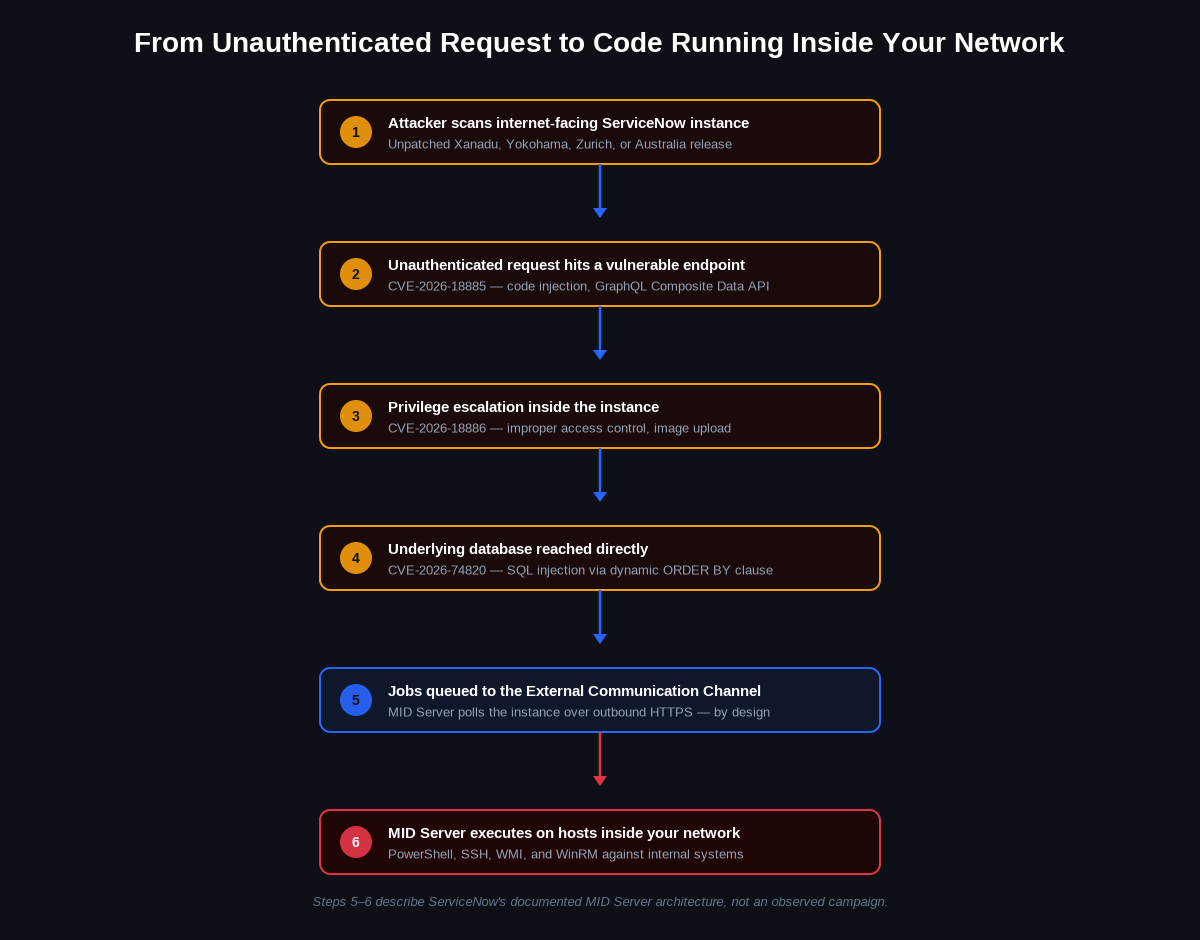
Public technical detail is deliberately thin — ServiceNow has not released exploitation specifics, and we are not going to invent an attack chain that has not been published. What the advisory descriptions do establish is the shape of each entry point and, more usefully, what an attacker inherits once inside.
- Reach an exposed instance. Every one of the three maximum-severity flaws is
PR:N/UI:N— no account, no phishing, no user to trick. Anything reachable over the network is a candidate. (The Hacker News) - Choose an entry point. Three independent ones were fixed in the same advisory:
- CVE-2026-18885 — code injection in the GraphQL Composite Data API, enabling arbitrary code execution and access to or modification of instance data.
- CVE-2026-18886 — improper access control in the system configuration image upload processor, allowing an unauthenticated user to create or modify instance data, resulting in privilege escalation.
- CVE-2026-74820 — SQL injection reached through a dynamic schema
ORDER BYclause, allowing arbitrary SQL against the instance's underlying database. (The Hacker News) - Escalate inside the platform. The access control flaw is the one that turns a foothold into an administrator. Creating or modifying instance data in a system where records govern roles and workflows is not a data-integrity problem; it is a privilege problem (MITRE ATT&CK T1068, Exploitation for Privilege Escalation).
- Harvest what the platform holds. Arbitrary SQL against the instance database reaches the CMDB, incident and change history, integration configuration, and stored credentials for connected systems (T1213, Data from Information Repositories; T1552, Unsecured Credentials).
- Pivot outward through the platform's own agent. This is the step that matters for endpoint defense, and it is covered below.
Payload and Impact
There is no malware family attached to this disclosure and no dropper to name. The impact is the platform's own capability, turned around.
The consequential piece of ServiceNow architecture here is the MID Server — a lightweight Java application that customers install inside their own network, running as a Windows service or a UNIX daemon. It polls the instance's External Communication Channel queue over outbound HTTPS, retrieves instructions, and executes them locally against internal infrastructure using SSH, WMI, WinRM, SNMP, JDBC, and PowerShell, then returns the results. (ServiceNow Community)
That design is entirely sensible: it means no inbound firewall holes are required for Discovery and Orchestration. It also means the instance is a command source for hosts inside your perimeter. An attacker who achieves administrative control of an instance does not need to break into the network separately — the network is already listening for instructions, and the MID Server host runs whatever comes back with the service account's privileges.
To be precise about the boundary: ServiceNow has published no evidence that any of these four CVEs has been used this way, and we are describing an architectural consequence of instance compromise, not a documented campaign. But it is the reason "it's a SaaS bug, not an endpoint problem" is the wrong conclusion to draw.
Why Traditional Defenses Struggle
- There is no file to scan at the point of exploitation. The initial compromise is a crafted HTTP request against an application endpoint. No binary is written, so signature-based antivirus has nothing to match.
- Post-exploitation activity looks legitimate. A MID Server executing a PowerShell command against an internal host is its documented job. Behavioral analytics tuned to "unusual process ancestry" see the same parent-child relationship they see every day during Discovery runs.
- Blocking the known request pattern is not patching. The CVE-2026-6875 episode demonstrated this concretely — Defused confirmed a second gadget chain that evaded defenses built around the published proof of concept. (SecurityWeek)
- Detection arrives after execution. Endpoint detection and response is a post-execution discipline by construction. It reports what already ran. When the compromise begins in a platform your endpoint agents cannot see, the first opportunity to intervene is the moment something tries to run on a host — and that opportunity is only useful if it is a deny, not an alert.
How White Cloud Security Trust Lockdown Stops This
Two things are true at once, and skipping either one would be dishonest.
White Cloud Security would not have prevented these vulnerabilities. The flawed code runs in the ServiceNow platform. There is nothing on your endpoints to allow or deny at the moment of injection, and no endpoint product changes that. The fix is the patch.
What White Cloud Security governs is the next step — whether a compromised instance can turn into executed code on your machines.
Least-Privilege Zero-Trust App Firewall
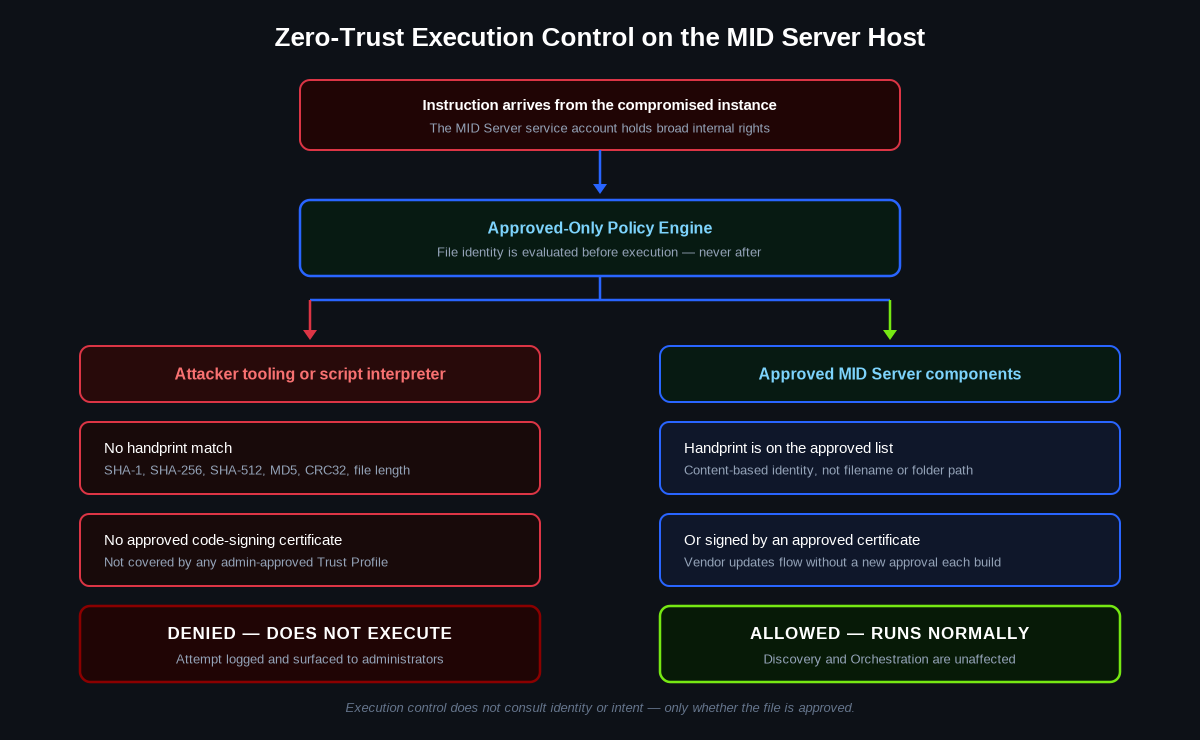
White Cloud Security (WCS) Trust Lockdown™ enforces Default-Deny Zero-Trust Application Control: only explicitly approved software is permitted to execute. Mapped against the chain above:
| Attack step | White Cloud Security control |
|---|---|
| 1–2. Unauthenticated request reaches the instance | Not covered. This is a patching problem. Apply KB3152242. |
| 3–4. Privilege escalation and data access inside the instance | Not covered. Enforcement is at the execution boundary on hosts, not inside the platform. |
| 5. Instructions queued to a MID Server host on your network | Denied at execution. An unapproved binary, script interpreter, or administrative tool has no handprint entry and no approved signer, so it does not run — regardless of which service account launched it. |
| 6. Lateral movement, persistence, ransomware staging | Denied at execution. Each subsequent stage is another unapproved executable meeting the same policy. |
The property that matters is that execution control does not consult identity or intent. It does not ask whether the request came from a legitimate Discovery schedule or from an attacker who owns the instance. It asks whether the file about to run is on the approved list. A MID Server service account with broad rights is still bounded by what policy permits it to launch.
This also constrains the living-off-the-land path. Trust Lockdown policies can restrict administrative interpreters and dual-use tools to the systems and contexts where they are genuinely needed, so a MID Server host is not an unrestricted launcher for whatever the platform hands it.
Handprint Identity
Approval in White Cloud Security is not a filename or a folder path — both of which an attacker with write access controls. Files are identified by handprint: a combination of SHA-1, SHA-256, SHA-512, MD5, CRC32, and file length. A tool renamed to look like a legitimate MID Server component still fails the check, because the identity that policy evaluates is the file's content, not its label. Trust can also be extended through Trust Profiles built on administrator-approved code-signing certificates, so vendor-signed updates flow without a new approval for every build.
At White Cloud Security, we continue to track and report new hacking methods and tools — not just because of their immediate threat, but because patterns of reuse often expose the playbooks of these cybercriminal groups.
To state the limit plainly: this is containment of the blast radius, not prevention of the vulnerability. Application control does not replace patching, network segmentation, credential hygiene, or instance-side monitoring. Against the injection itself it does nothing.
Recommended Mitigations
- Identify your release and patch level now, then compare it against the affected list in ServiceNow advisory KB3152242 and apply the corresponding patch or hot fix. (ServiceNow)
- Do not assume you are covered because you are on SaaS. ServiceNow patches the instances it hosts, but self-hosted and self-managed instances — including non-production clones and sandboxes — must be patched by you.
- Include lower environments. Development and test instances frequently carry production-like CMDB data and real integration credentials, and are less likely to be patched promptly.
- Reduce exposure. Restrict instance access to known networks or an identity-aware proxy where your workflow allows it. Do not rely on request-pattern filtering as a substitute for the patch — that approach was demonstrably bypassed against CVE-2026-6875. (SecurityWeek)
- Review MID Server posture. Run MID Servers under least-privilege service accounts, segment the hosts they sit on, and audit which credentials those hosts can use against the rest of the estate.
- Hunt retroactively in instance logs. Examine authentication records, database activity, changes to user and role records, privileged actions, and the ECC queue for jobs no schedule accounts for.
- Rotate integration credentials stored in or reachable from any instance you cannot confirm was patched before exposure.
- Enforce Default-Deny application control on MID Server hosts and on the servers those hosts can reach, so that a platform compromise cannot become arbitrary code running in your network.
Indicators of Compromise
None have been published for CVE-2026-18885, CVE-2026-18886, CVE-2026-74820, or CVE-2026-6876. ServiceNow has released no attack-chain details, no proof of concept, and no indicator set for these four issues, and we will not manufacture indicators to fill the gap.
For the earlier, actively exploited CVE-2026-6875, reporting identified exploitation attempts directed at the /assessment_thanks.do endpoint, with at least one captured payload matching Searchlight Cyber's published proof of concept and a second, distinct gadget chain observed subsequently. (BleepingComputer) (SecurityWeek) Regarding that activity, ServiceNow stated: "Based on our investigation to date, we have not observed evidence that this activity is related to instances that ServiceNow hosts." (The Hacker News)
Key Takeaways
- Three CVSS 10.0 flaws and one at 8.7 were fixed in a single ServiceNow advisory, all reachable without authentication and without user interaction. (The Hacker News)
- Patch against KB3152242. Verify your release family and patch level rather than assuming your instance is current, and do not overlook sandboxes and clones. (ServiceNow)
- "No public exploit yet" is a timestamp, not a status. The comparable CVE-2026-6875 was exploited in the wild within days of its patch, and a second gadget chain defeated defenses tuned to the published PoC. (Help Net Security) (SecurityWeek)
- The endpoint risk is the MID Server. ServiceNow's own architecture places an agent inside your network that executes instructions from the instance — so instance compromise is a route to code running on internal hosts. (ServiceNow Community)
- No endpoint product, White Cloud Security included, prevents this class of vulnerability. The vulnerable code is not on your machines.
- White Cloud Security limits what a compromised platform can accomplish afterward. Default-Deny execution control denies unapproved software on MID Server hosts and the servers they reach, identified by handprint rather than by name or path — containment after a platform failure, not a substitute for the patch.
References
- The Hacker News — "Three CVSS 10.0 ServiceNow Flaws Could Let Unauthenticated Attackers Execute Code and SQL," August 27, 2026
- ServiceNow — "August 2026 CVE Advisory Notification," KB3152242
- GBHackers — "ServiceNow Patches Critical Flaws Enabling Unauthenticated RCE and SQL Injection"
- Help Net Security — "ServiceNow pre-auth RCE exploited in the wild (CVE-2026-6875)," July 20, 2026
- BleepingComputer — "Critical ServiceNow code execution flaw now exploited in attacks"
- SecurityWeek — "Exploitation of ServiceNow Vulnerability Seen Days After Disclosure"
- ServiceNow Community — "The special agent of ServiceNow: MID Server"
Further Reading
- A CVSS 10.0 in Your Identity Provider, and Nothing to Patch: Entra ID CVE-2026-69836
- JADEPUFFER: The First Ransomware Run End-to-End by an AI Agent
- Microsoft Defender RoguePlanet Zero-Day: When SYSTEM Privileges Are Not Enough
- When Your AI Tool Becomes the Attacker's Front Door: The Vercel Breach and OAuth Trust Abuse
- XAA Controls AI Agent Access. WCS Controls What Software Can Run.
ServiceNow, Now Platform, and Xanadu, Yokohama, Zurich, and Australia release names are trademarks of ServiceNow, Inc. ServiceNow is not affiliated with, and does not endorse, White Cloud Security, Inc. All technical details of CVE-2026-18885, CVE-2026-18886, CVE-2026-74820, and CVE-2026-6876 are drawn from the sources linked above. Trust Lockdown™ is a trademark of White Cloud Security, Inc.