When Your Own Server Hands Out the Malware: Head Mare Trojanizes TrueConf Client Installers
Attackers broke into unpatched TrueConf video-conferencing servers, swapped the client installer for a backdoored copy, and let the organization's own conference server deliver PhantomCore to its users
Date: August 8, 2026 Primary Source: Kaspersky ICS CERT · Securelist · BleepingComputer
Executive Summary
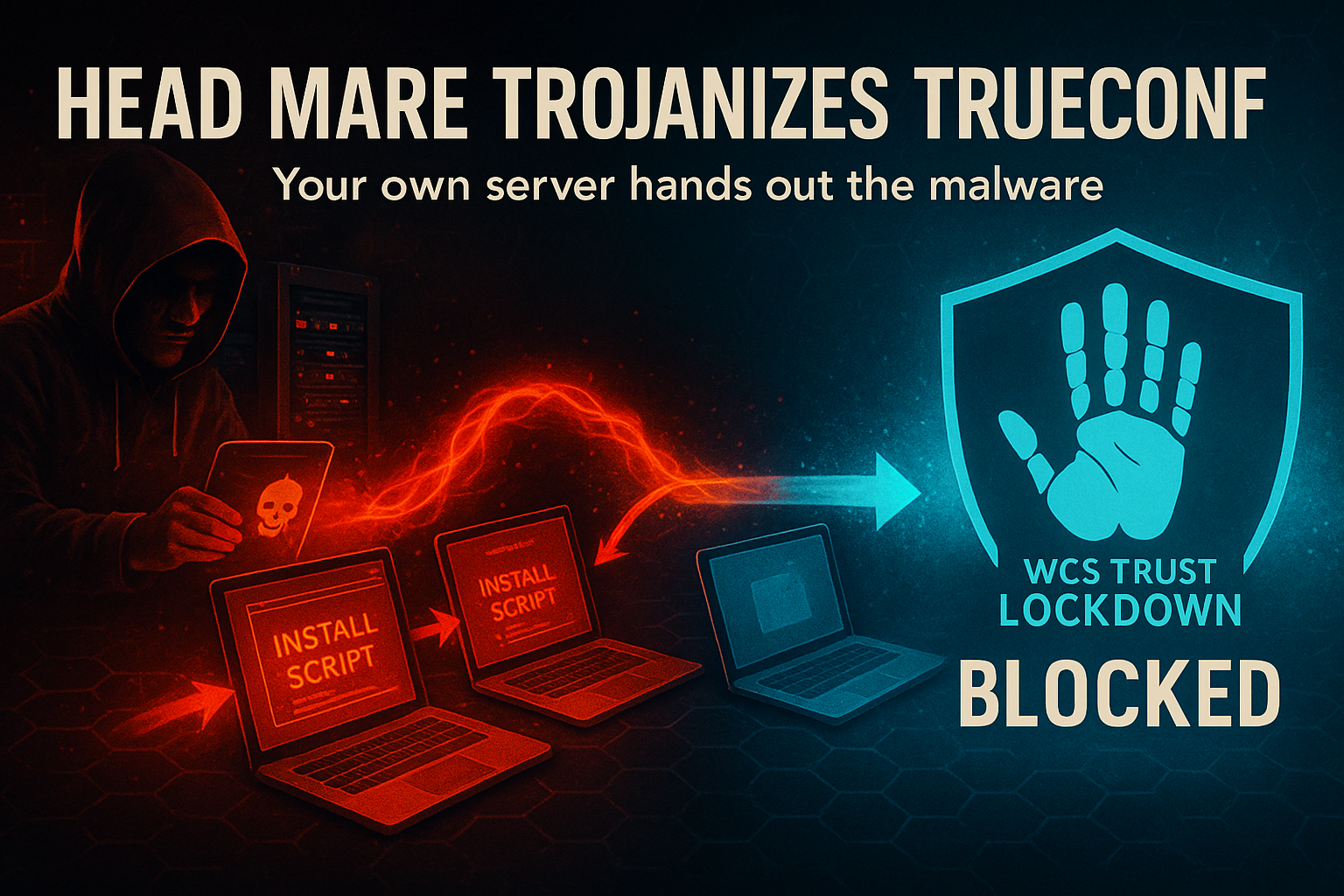
- What: The hacktivist group Head Mare exploited two vulnerabilities in on-premises TrueConf Server to get NT AUTHORITY\SYSTEM on the server. It then planted a PHP web shell and replaced the TrueConf client installer the server hosts with an unsigned, trojanized copy. Employees who downloaded or updated the client from their own company's server installed the PhantomCore backdoor. The PhantomGraph backdoor was deployed as well. (Kaspersky ICS CERT) (BleepingComputer)
- Who is affected: Organizations running self-hosted TrueConf Server 5.3.x before 5.3.9, 5.4.x before 5.4.9, 5.5.x before 5.5.5, and older branches. Kaspersky says all versions since 2022 are affected. The observed victims are Russian organizations in instrument making, electronics, transportation, energy, IT, and software development. (Kaspersky ICS CERT) (Securelist)
- Severity: Critical. CVE-2026-72529 (KLCERT-26-057) is rated CVSS 9.3, and CVE-2026-72530 (KLCERT-26-058) is rated CVSS 9.5. CISA added both to its Known Exploited Vulnerabilities catalog on August 20, 2026. (The Hacker News) (SecurityWeek)
- Action required: Upgrade TrueConf Server to 5.3.9, 5.4.9, or 5.5.5. These fixes were released on June 18, 2026. Restrict TCP 4307 to trusted networks, and check the client installers your server is handing out. (Kaspersky ICS CERT) (Alexander V. Leonov)
- The honest scope note: White Cloud Security does not patch TrueConf, and it does not stop the server exploit or a PHP web shell running inside the approved web server. What it governs is the part of this attack aimed at everyone else: whether a tampered installer and the unapproved DLLs it drops are permitted to execute on your endpoints.
Overview
Most supply-chain stories involve a vendor's download site. This one is closer to home. The trojanized installer didn't come from the internet. It came from the organization's own internal video-conferencing server, which users had every reason to trust.
Kaspersky found the activity in July 2026 and published its research in August. BleepingComputer reported on it August 8, The Hacker News on August 10, Securelist on August 11, and Kaspersky ICS CERT released its full technical report with indicators on August 12. (BleepingComputer) (The Hacker News) (Securelist) (Kaspersky ICS CERT) Head Mare has targeted organizations in Russia and Belarus since at least 2023. According to The Hacker News, it had already exploited earlier TrueConf zero-days (BDU:2025-10114, BDU:2025-10115, BDU:2025-10116) starting in September 2025. (SecurityWeek) (The Hacker News)
The victims in this campaign are Russian. The technique isn't specific to any country, though, and it has been used before. In March 2026, Check Point described TrueChaos, a campaign it attributed with moderate confidence to a Chinese-nexus actor. That actor used CVE-2026-3502, a missing integrity check in the TrueConf client's update process, to push tampered updates from a controlled on-premises TrueConf server to government endpoints in Southeast Asia. (The Hacker News) For any organization, including the US and Western SMBs that make up most of our readers, the lesson is the same. An internal server that distributes software is a watering hole waiting to happen. Examples include a conferencing server, a software deployment share, an intranet download page, or an RMM repository.
Threat Summary
| Field | Detail |
|---|---|
| CVE ID(s) | CVE-2026-72529 (KLCERT-26-057), CVE-2026-72530 (KLCERT-26-058) |
| CVSS Score | 9.3 and 9.5, Critical (The Hacker News) |
| Weakness | Missing authentication for a critical function; breakout from an isolated (sandbox) environment (Kaspersky ICS CERT) |
| Affected Products | TrueConf Server 5.3.x < 5.3.9, 5.4.x < 5.4.9, 5.5.x < 5.5.5, the 5.2 branch and earlier (Alexander V. Leonov) |
| Attack Vector | Network: unauthenticated access to TCP 4307, open by default (Kaspersky ICS CERT) |
| Exploited in the Wild | Yes, since July 2026. On CISA KEV since August 20, 2026 (SecurityWeek) |
| Patch Available | Yes, June 18, 2026 (5.3.9 / 5.4.9 / 5.5.5) (Kaspersky ICS CERT) |
| Threat Actor | Head Mare |
| Payloads | PhantomCore (backdoor delivered through the trojanized client), PhantomGraph (SysExcSvc.dll, SysReadSvc.dll), Linux backdoors, and a rootkit (Kaspersky ICS CERT) |
Technical Analysis
How the Attack Works
- Reach the server. The attacker connects to TrueConf Server on TCP 4307 and calls an undocumented function that needs no authentication (MITRE ATT&CK T1190, Exploit Public-Facing Application). (Kaspersky ICS CERT)
- Run a script in the sandbox. Through CVE-2026-72529, the attacker uploads a script and runs it inside TrueConf's isolated scripting environment. (Kaspersky ICS CERT)
- Escape to SYSTEM. CVE-2026-72530 breaks out of that environment and runs arbitrary code on the host as NT AUTHORITY\SYSTEM (T1068). (Kaspersky ICS CERT)
- Plant a web shell and cover tracks. The attacker replaces the server's own
C:/Program Files/TrueConf Server/httpconf/site/public/js/locale.phpwith a PHP web shell (T1505.003) and deletes the TrueConf event-log entries covering the exploit (T1070). (Kaspersky ICS CERT) (Securelist) - Swap the client installer. Working through the web shell, the attacker modifies the client installer the server distributes,
C:\Program Files\TrueConf Server\ClientInstFiles\trueconf_windows_client_x64.exe(T1195.002, Compromise Software Supply Chain). Kaspersky notes that the malicious distributions "did not have a valid digital signature." (Kaspersky ICS CERT) (Securelist) - Let users infect themselves. Conference participants get an upgrade prompt and download the infected installer from the trusted internal server (T1204.002, User Execution). (Kaspersky ICS CERT)
- Establish PhantomCore. The installer drops PhantomCore as
%LOCALAPPDATA%\TrueConf\Client\api-ms-win-crt-time-l1-1-0-2.dll. The file name imitates a Windows runtime library. It persists through a COM hijack: a per-userInprocServer32registry key points a CLSID at the malicious DLL (T1546.015). (Kaspersky ICS CERT) (Securelist)
Payload and Impact
PhantomCore is Head Mare's backdoor and remote-access tool. PhantomGraph is a two-part DLL backdoor: SysExcSvc.dll receives commands through Microsoft OneDrive, and SysReadSvc.dll runs them through batch files. Base64-encoded PowerShell installs both as Windows services with matching names. (Securelist) (BleepingComputer) On Linux and other Unix-like systems, Kaspersky found separate backdoors registered as systemd services (omicluster.service, schedul2-bin.service), a rootkit, and a GitHub repository used as an alternate command channel. (Kaspersky ICS CERT)
Once inside, the operators dumped LSASS memory using the built-in comsvcs.dll to steal credentials. They also ran reconnaissance commands and set up reverse SSH tunnels for durable access. (Securelist) (BleepingComputer) The business impact is broad. It starts with a single compromised server and ends with backdoors on every workstation that trusted that server's installer, plus the credentials needed to move further.
Why Traditional Defenses Struggle
- The download source is trusted. URL filtering, proxy categories, and user awareness training all teach people to be wary of unfamiliar websites. This installer came from an internal hostname users visit every day, in response to an upgrade prompt from the application itself.
- The file name is the real one. The trojanized file sits at the legitimate installer path under the legitimate name. Allow-listing by path or name doesn't help here, because the attacker controls both on a compromised server.
- The first stage leaves little to scan. A PHP web shell and scripts running in TrueConf's own engine are hard to tell apart from normal server activity, and the attacker wiped the relevant event-log entries. (Kaspersky ICS CERT)
- Command and control rides on popular cloud services. Traffic to OneDrive and GitHub looks like normal business traffic, which weakens network-reputation blocking. (Kaspersky ICS CERT)
- Detection comes after execution. EDR may flag the COM hijack or the service install, but only after the backdoor has run, and it has to catch it on every endpoint that downloaded the installer.
How White Cloud Security Trust Lockdown Stops This
Two things are true here, and leaving out either one would be dishonest.
White Cloud Security would not prevent the server compromise. The TCP 4307 exploit and the sandbox escape run inside TrueConf's own approved server process. The locale.php web shell runs inside the approved web server and PHP interpreter, which have to keep running for TrueConf to work. Application control doesn't inspect what an approved process is told to do. The fix for those steps is the June 18 patch and network restriction.
What White Cloud Security governs is the distribution step, and that's where this campaign turned one server into many victims.
Least-Privilege Zero-Trust App Firewall
White Cloud Security (WCS) Trust Lockdown™ enforces Default-Deny Zero-Trust Application Control. Only applications, libraries, and scripts explicitly approved for an endpoint are permitted to execute.
| Attack step | White Cloud Security control |
|---|---|
| 1–3. Unauthenticated call on TCP 4307 → sandbox script → escape to SYSTEM | Not covered. This runs inside the approved TrueConf Server process. Patch to 5.3.9 / 5.4.9 / 5.5.5 and restrict TCP 4307. |
4. locale.php web shell and event-log deletion |
Not covered. A PHP script interpreted by the approved web server is outside execution control. File-integrity monitoring and log forwarding apply here. |
| 5. Attacker replaces the hosted client installer | Not covered. Writing a file to a server isn't execution. The file is stopped when someone tries to run it. |
6. User runs the tampered trueconf_windows_client_x64.exe |
Denied at execution. The modified installer's handprint doesn't match any approved TrueConf build, and because it's unsigned, it doesn't match a Trust Profile for TrueConf's approved code-signing certificate. (Securelist) |
| 7. PhantomCore DLL loaded through the COM hijack | Denied at load. Trust Lockdown governs libraries as well as executables, so an unapproved DLL in %LOCALAPPDATA% doesn't load, whatever CLSID points to it. |
8. PhantomGraph SysExcSvc.dll / SysReadSvc.dll services on a protected host |
Denied at load. They're unapproved libraries. Registering them as services doesn't make them approved. |
9. Batch files written to %TEMP% by PhantomGraph |
Denied unless approved. Trust Lockdown governs scripts, so unapproved cmd_cmd_*.bat files don't run. |
10. Linux backdoors and rootkit binaries (/omi/bin/omicluster, /opt/acronis/bin/schedul2-bin) |
Denied at execution on WCS-protected Linux hosts. |
11. LSASS dump through comsvcs.dll with rundll32.exe |
Only partly covered. These are approved Windows components. Restricting rundll32.exe and dual-use tools to the contexts that need them reduces this path. Credential Guard and EDR address it directly. |
If WCS is also deployed on the TrueConf server itself, the same default-deny policy applies to what the web shell tries to launch there. PhantomGraph DLLs, dropped tunneling tools, and Linux backdoor binaries all need approval before they run. The web shell's own PHP code does not.
Handprint Identity
This campaign is a clear example of why identity has to come from the file itself and not from where it's stored. The trojanized installer had the right name, in the right folder, on the right server. White Cloud Security identifies files by handprint: a combination of SHA-1, SHA-256, SHA-512, MD5, CRC32, and file length. A single modified byte produces a different handprint, so a tampered copy of an approved installer is a different, unapproved file.
Trust Profiles handle legitimate updates. When an administrator approves TrueConf's code-signing certificate, properly signed new client builds are permitted without a per-build approval. Kaspersky found that the malicious distributions lacked a valid signature, so they fail that check. (Securelist) Kaspersky's own detection guidance points the same way: it recommends flagging unsigned TrueConf installers. (Securelist)
At White Cloud Security, we continue to track and report new hacking methods and tools — not just because of its immediate threat, but because patterns of reuse often expose the playbooks of these cybercriminal groups.
To state the limit plainly: White Cloud Security contains the spread, not the server compromise. It doesn't stop the TrueConf exploit or the PHP web shell. An attacker whose goals can be met from inside the TrueConf server process, such as reading meeting data or the TrueConf database, isn't stopped by execution control. If an administrator approves the tampered installer by hand because "it came from our own server," the policy will permit it. Application control doesn't replace patching, network segmentation, MFA, EDR, log monitoring, or backups. It's the layer that decides whether a compromised internal server can push unapproved code onto every endpoint that trusts it.
Recommended Mitigations
- Patch TrueConf Server to 5.3.9, 5.4.9, or 5.5.5 or later. If you can't patch right away, restrict TCP 4307 to trusted networks. (Kaspersky ICS CERT) (Alexander V. Leonov)
- Verify what your server distributes. Check the signature and hash of every installer under
ClientInstFiles, and compare them with the vendor's release. Treat any unsigned TrueConf installer as suspect. (Securelist) - Check for the web shell. Compare
...\httpconf\site\public\js\locale.phpwith a known-good copy, and review the server for gaps in TrueConf event logs. (Kaspersky ICS CERT) - Update TrueConf clients to 8.5.3 or later to close the separate CVE-2026-3502 update-integrity flaw used in TrueChaos. (The Hacker News)
- Hunt on endpoints for the COM-hijack key below, for DLLs under
%LOCALAPPDATA%\TrueConf\Client\with runtime-library names, and for services namedSysExcSvcorSysReadSvc. - Protect LSASS with Credential Guard or LSA protection, and alert on
rundll32.exeloadingcomsvcs.dllwithMiniDump. - Inventory every internal software-distribution point, including conferencing servers, deployment shares, and intranet download pages. Treat each one as a supply-chain dependency with integrity monitoring.
- Enforce Default-Deny application control with approved code-signing Trust Profiles, so that a tampered installer from any internal source is denied on endpoints.
Indicators of Compromise
These are selected from the indicators published by Kaspersky ICS CERT and Securelist. (Kaspersky ICS CERT) (Securelist) See the source reports for the full list.
MD5 hashes
4d27b4eb1c5dbb3d8160f29b8119523e: web shell (locale.php)748c9f8cb1065000616204935f96207f: malicious installer (trueconf_windows_update.exe)c5a460e4e68a088f6e51b2c6474642ec: PhantomCore2bb75c20e778eb5c416965bd4d4259b1:trueconf_windows_client_x64_[redacted].exe489f43be558b2679284ceabed7adc4f3,0e4541c3153ec5ed01497f19cf4f63d0,12d4e8f5295f2ef7e0f9bfc0f4830939,7f267006cac10f341c356b62fe493527,ee2861d5965e8730708cd1da8a93fa4c,dd1fd2b459b97b7d59375cb8383cd19a: PhantomGraphc3a2abe8756910f42582b04a44ea3514,43f435c3c437bc879a2d7d4634f43494: Linux backdooraee9642b45b099cb7f3053b9b680b425: rootkit
Network
- IPs:
81.177.32[.]12,194.87.239[.]71,194.87.93[.]153,38.244.205[.]244,31.59.102[.]61 - Domains:
penzadogshelter[.]site,trendy-market[.]site,bright-deals[.]site,nova-stream[.]site,rinomobile[.]ink,urbanpixel[.]store,flexish[.]shop,media-hub[.]today,cosmetic-deals[.]store,vks.gossopka[.]forum
Host
HKCU\Software\Classes\CLSID\{0340F119-A598-4ed9-B0AC-6F6A12D3E755}\InprocServer32%LOCALAPPDATA%\TrueConf\Client\api-ms-win-crt-time-l1-1-0-2.dllC:\Windows\System32\inetsrv\SysExcSvc.dll,C:\Windows\System32\inetsrv\SysReadSvc.dll,C:\Windows\System32\inetsrv\graphi-refresh.dat- Services:
SysExcSvc,SysReadSvc /etc/systemd/system/omicluster.service,/etc/systemd/system/schedul2-bin.service,/usr/lib64/libzvbi-tchain.so.2,/var/tmp/cx2
Key Takeaways
- Head Mare turned unpatched TrueConf servers into malware distribution points. The fixes shipped June 18, and exploitation began in July. (Kaspersky ICS CERT)
- CVE-2026-72529 and CVE-2026-72530 are on CISA's KEV list. Together they give an unauthenticated attacker SYSTEM on the server. (SecurityWeek)
- The most damaging step was the quietest one: replacing an installer that users trusted because it came from their own server.
- This is a repeat pattern. TrueChaos used a TrueConf server to push tampered updates in March 2026. (The Hacker News)
- No endpoint product, White Cloud Security included, stops a PHP web shell running inside an approved web server. The fix for the vulnerability is the patch.
- White Cloud Security limits how far the compromise spreads. Handprint identity and Trust Profiles would help deny an unsigned, modified installer and the unapproved DLLs it drops, even when it arrives from a trusted internal source under its legitimate name.
References
- Kaspersky ICS CERT — "Head Mare APT group exploits vulnerabilities in unpatched TrueConf server to deliver PhantomCore malware to conference participants," August 12, 2026
- Securelist (Kaspersky) — "Head Mare targets TrueConf Server with PhantomCore," August 2026
- BleepingComputer — "Hackers breach TrueConf to trojanize client installers with backdoors," August 8, 2026
- The Hacker News — "TrueConf Server Flaws Exploited to Replace Client Installers with PhantomCore," August 10, 2026
- SecurityWeek — "CISA Urges Immediate Patching of Exploited TrueConf Vulnerabilities," August 21, 2026
- Alexander V. Leonov — "About Remote Code Execution – TrueConf Server (CVE-2026-72529, CVE-2026-72530) vulnerability," September 3, 2026
- The Hacker News — "TrueConf Zero-Day Exploited in Attacks on Southeast Asian Government Networks," March 31, 2026
Further Reading
- When a "Zoom Installer" Is Not Zoom
- When Trusted Tools Turn Malicious: The CPU-Z and HWMonitor Supply Chain Breach
- Notepad++ Supply Chain Attack: Chinese State Hackers Hijacked Software Updates for Months
- Three CVSS 10.0 Flaws in ServiceNow: When the Workflow Platform Becomes a Remote Console
TrueConf is a trademark of TrueConf LLC. Microsoft, OneDrive, and Windows are trademarks of Microsoft Corporation. Neither company is affiliated with, or endorses, White Cloud Security, Inc. Technical details of CVE-2026-72529, CVE-2026-72530, PhantomCore, and PhantomGraph are drawn from the sources linked above. Trust Lockdown™ is a trademark of White Cloud Security, Inc.